Big Dot Games – “A good game you can see from a mile off”


Will Carey is a designer and developer, and the person behind Big Dot Games. His new game, The Landlords, is a free digital edition of The Landlord’s Game, the board game Lizzie Magie patented in 1904, thirty-one years before Monopoly was sold to Parker Brothers. It comes out on Steam in December 2026 with both of Magie’s original rulesets, a custom rules editor and a three-act story campaign. We talked about Flash, a babysitter’s piano trick, a time-travelling physicist, and why honesty about AI matters more than the tool.
Getting started
You studied art and design, and that’s what you do for a living. When did you first want to make games, and what was the first thing you made?
At high school in the late 1990s we started messing about with a piece of software called Macromedia Flash. It later became Adobe Flash, and it’s now more or less completely deprecated. At the time, Flash games and animations were really popular on the internet. There were sites like Joe Cartoon with interactive cartoons, and we had fun making our own cartoons and small interactive games. That was my introduction to making games.
My first proper game came in 2009, when I was at university. It was still in Flash, but a lot more fleshed out: a big project called Piano Hero Junior, a rhythm game that taught children to play the piano using numbers. It was based on the way my babysitter taught me to play many years ago.
How did that work?
This nice young lady would sellotape the numbers 1 to 8 onto the middle octave of the piano and get me to practise songs using the numbers. “How Much Is That Doggie in the Window?” was 585-316-5352. We didn’t learn the notes or anything like that. It was a really good introduction to the piano, just getting a feel for rhythm and sound, and that’s what I carried over into the game many years later.
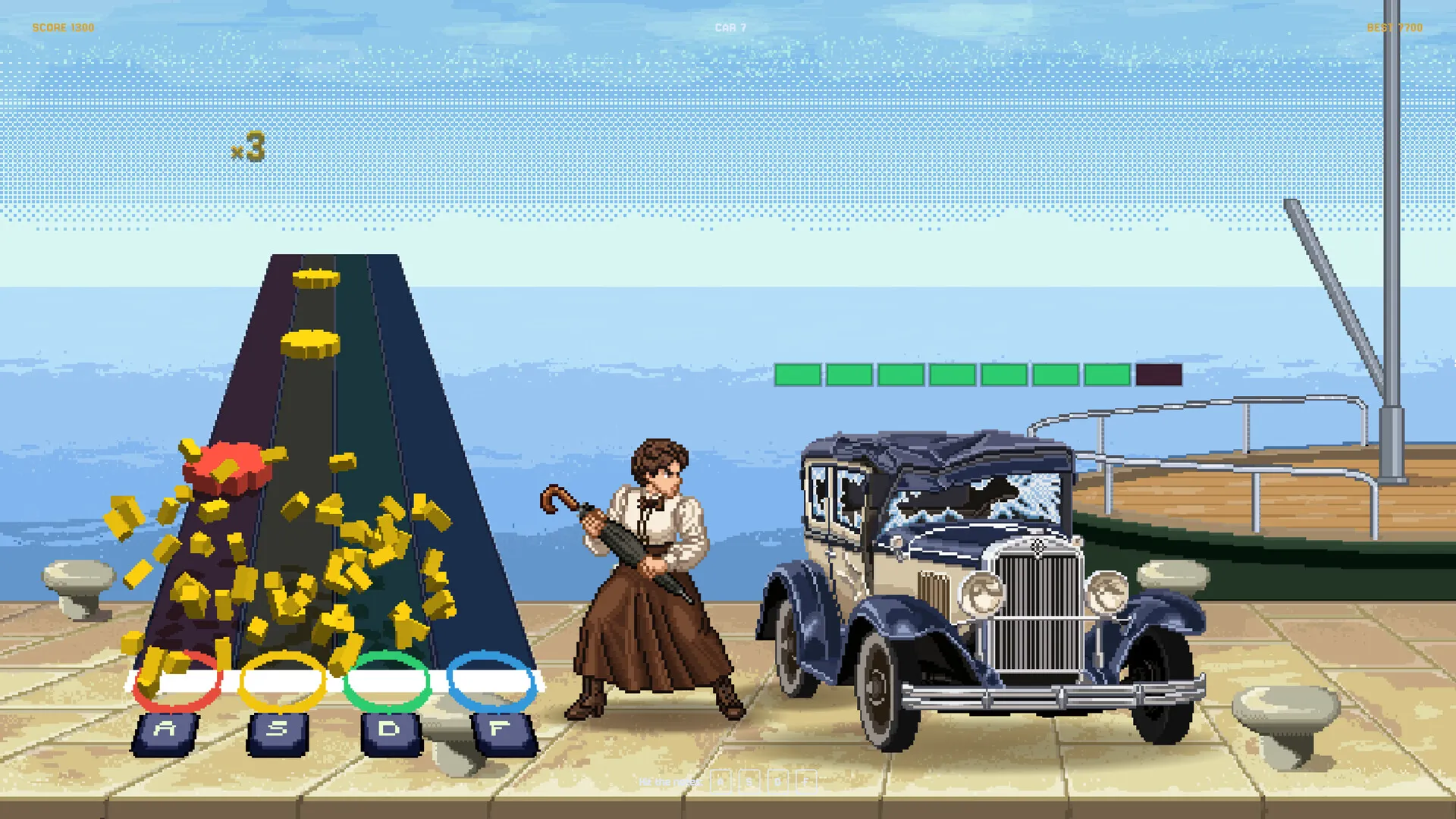
There’s a rhythm game in The Landlords too. It’s one of the minigames in the campaign, called Car Smash. It’s also a homage to the car-smashing bonus stages in Final Fight and Street Fighter II, and it takes a cue from games like Dave the Diver.

There’s a long gap between 2009 and The Landlords. What happened in between?
My degree was in graphic design, and that’s what I went into first, before moving into web design and then application development. During COVID we were building very complex applications that read COVID test results using machine learning and issued fit-to-fly certificates automatically. Around then I began to realise I was building the skills I’d need to put some of my own ideas into practice.
But it wasn’t until the run-up to Christmas 2025 that I started, for my own use, on a reimagining of Westwood’s 1995 Monopoly game for PC. I worked on it for about five weeks.
From Monopoly to Lizzie Magie
So it began as a personal remake of a Monopoly game. How did it become a free edition of Lizzie Magie’s original?
There was never any intention to release it. But as I spent more and more time on it, it felt like if I was going to raise the production value, I should make it more widely available.
I’ve always been a big fan of Monopoly, going back to that Westwood game and to the physical board game when I was young. Around 2007 I even played in the qualifying rounds of the World Monopoly Championship in Blackpool. But despite all that interest, I never knew the game’s history. I wasn’t alone. A lot of people would tell you Charles Darrow invented it, because that was the party line printed in the box.
When I started digging into the history, I thought this was something everyone should know. That gave me the motivation to make a fully rounded game that tells the story and lets people play the original game from over a hundred years ago, for free.
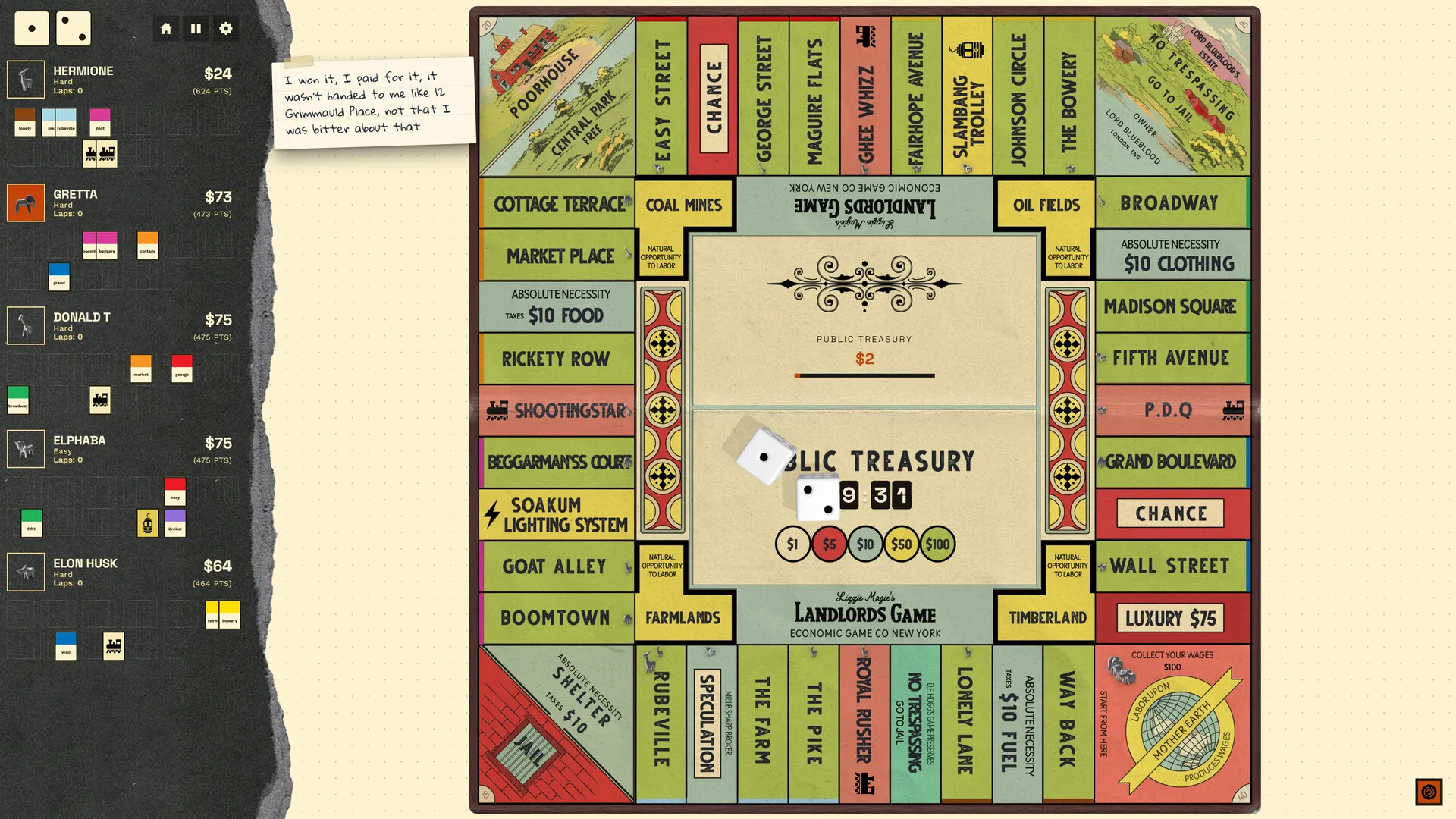
Magie wrote two sets of rules: the Monopolist rules, where one player bankrupts the rest, and the Prosperity rules, where rent goes to a public treasury and the whole table does better. Having played both, what did her original show you?
It highlights something important. The game evolved over the decades, and it evolved to become more enjoyable. People changed it to make it more fun to play.
The Prosperity ruleset is interesting, and it’s educational, which is what it was designed to be. It was made to teach people about the single tax. But it isn’t necessarily as fun as the Monopolist ruleset.
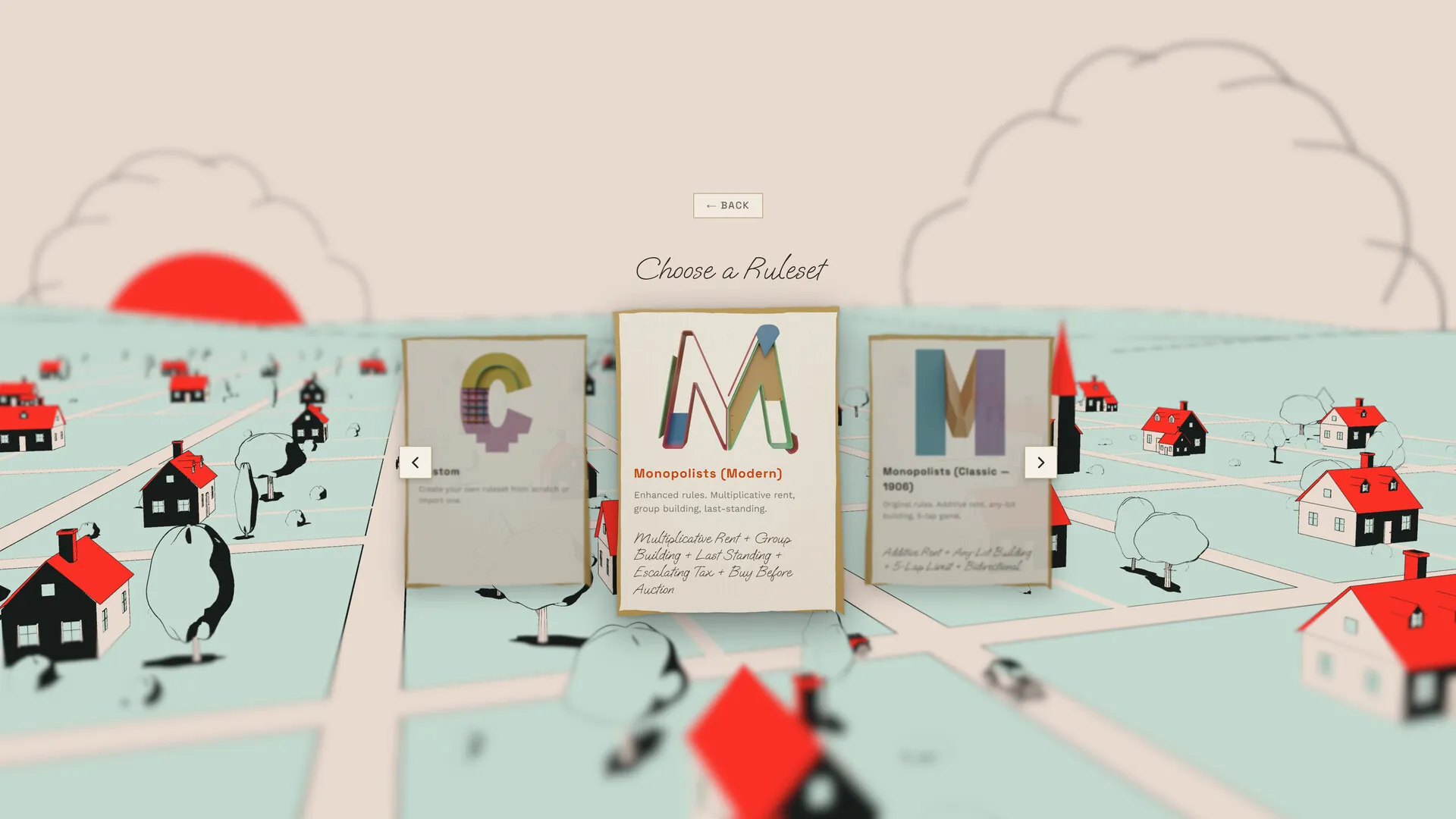
Our game gives players the choice. They can play the Monopolist rules or the original Prosperity rules, and they’re very much encouraged to try them. But they can also customise the rules completely, the way people did when they hand-drew the game on the living room floor, and the way people still do with modern Monopoly. People have house rules, and I think that’s great.
Telling the story
Magie’s story is about a woman written out of her own invention and paid $500 for it. Yet your campaign has a time-travelling physicist, a holographic sidekick, a pig-shaped computer, and Lizzie smashing Charles Darrow’s car with an umbrella. Why comedy?
It was an easy choice. Lizzie Magie was known for her sense of humour and her wit, and we wanted our game to be the same.
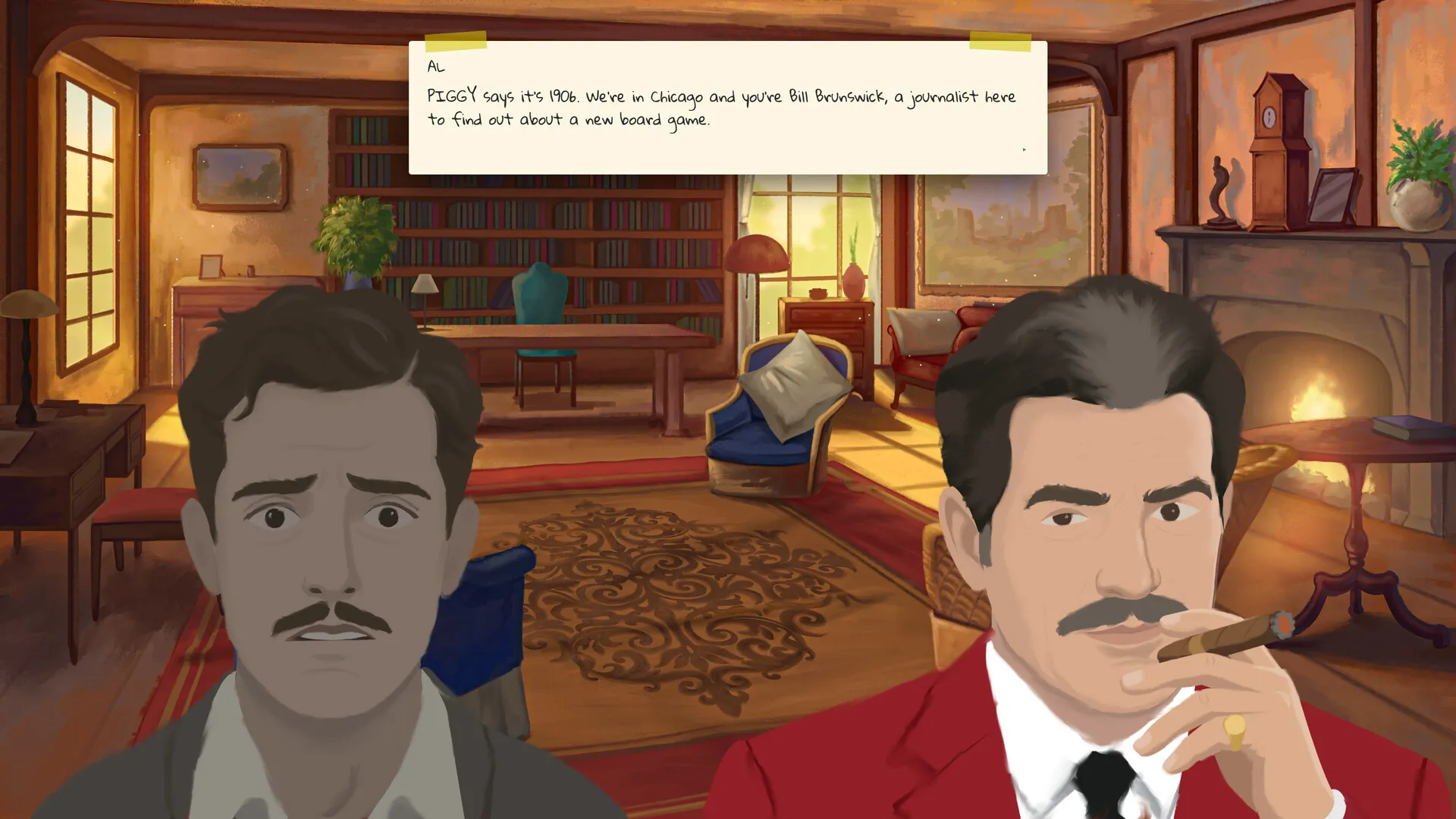
To tell the story, you play Dr Sam Bucket, a time-travelling physicist who leaps back in time into people who appear in the story of The Landlord’s Game. It’s a homage to Quantum Leap, of course. Using that as a storytelling device let us tell a story that spans several decades and several American states.
Did you worry that the silliness might undercut the injustice?
Yes, I do worry that the silliness could undercut what could be seen as quite a serious injustice. I hope it doesn’t. What I will say is that we treat the story and the game with reverence and respect.
The 162nd 366 Award goes to Big Dot Games for their outstanding creative work.
Art, trust and AI
The campaign’s painted backgrounds had a difficult start. What happened?
It’s an interesting time to be hiring artists, especially freelancers you work with remotely and haven’t worked with before. Generative AI art is becoming far more common and much harder to spot, especially when it’s done well. If independent developers don’t want generative art in their work and they’re hiring artists, that’s the minefield they have to navigate. I experienced it first-hand.
It was unfortunate, because I specifically wanted to hire a lesser-known artist, so I went with someone who didn’t have many customer reviews. The portfolio looked nice, and it wasn’t AI-generated, but of course you can get a portfolio from anywhere. I was clear that I didn’t want AI used to make the work.
To cut a long story short, a lot of time and money was wasted when this “artist” delivered work that was obviously AI-generated, and then promptly disappeared. After that we hired a really good artist, who made a first version before anything was agreed. It was so good. He did all three of the large backgrounds for the campaign.
What does that mean for artists just starting out?
That’s the problem it doesn’t solve. If you’re a new artist, how do you make a name for yourself and actually win clients, when people are afraid to hire anyone who can’t prove they make their work by hand?
In the finished game, each background paints itself in, layer by layer, in the order it was painted. Is that about proving the art is hand-made?
I don’t think game makers should have to show their work. In fact, I think it’s sad if they feel obliged to show how the sausage was made, to prove it wasn’t created by a computer. Don’t get me wrong, I think it looks pretty good in our case, and I really like how the backgrounds build up. But I probably wouldn’t have done it without that first experience. We’re living in a time when game developers sometimes have to prove these things to avoid the ire of people who are strongly against AI.
Yet most of the in-game music was made with Suno, and you’ve said so openly. Where do you draw the line?
Generative AI is polarising, and my own feelings about it are complicated. But one thing is crystal clear: you shouldn’t sell someone something and pretend you made it yourself when a computer created it. That goes for artists selling their work, and for game developers selling a game as hand-made when generative AI was used for the art.
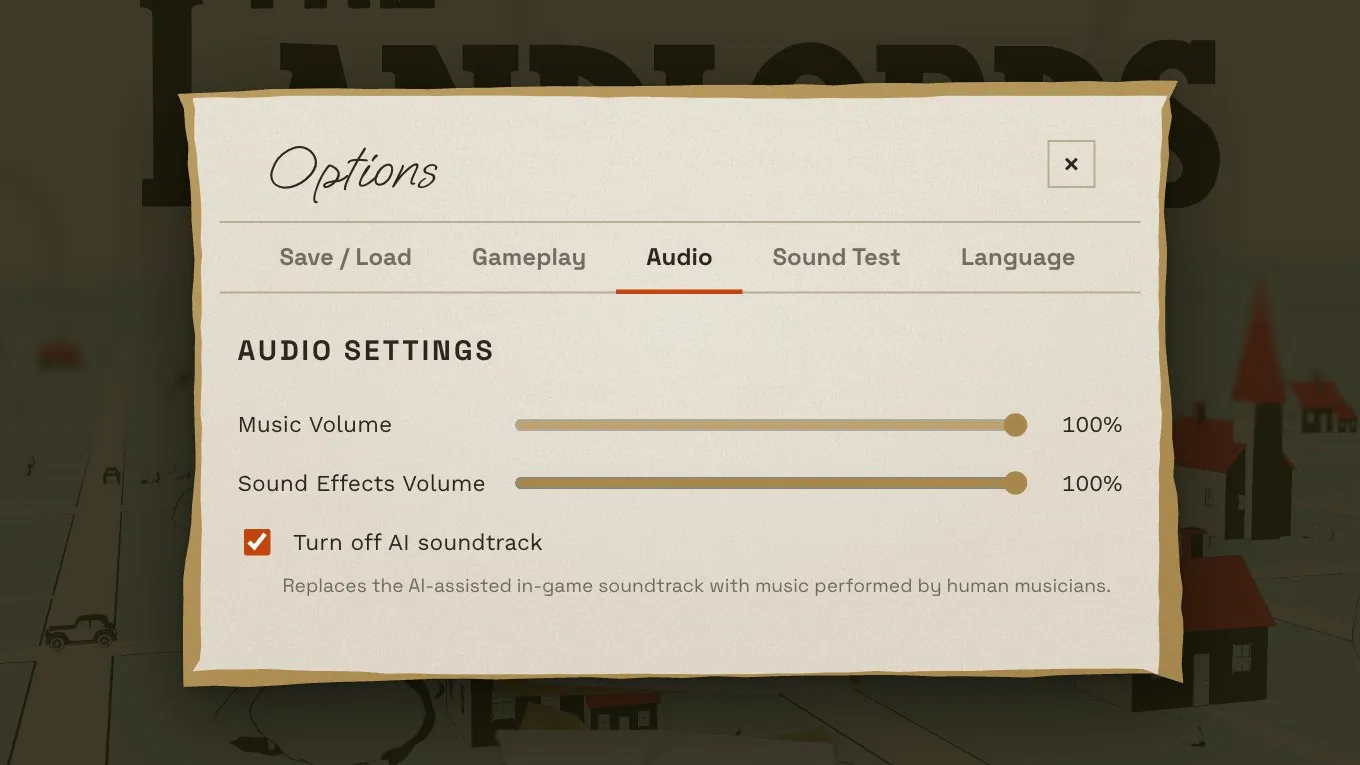
It was very important to me to be transparent about the generated soundtrack. We’re giving the game away for free, so you can imagine a highly skilled band and several weeks in a recording studio just weren’t on the cards. But I also understand that some people, especially at the moment, are very strongly against it. So we decided to let players switch to a standard licensed soundtrack, music that wasn’t made specifically for the game.
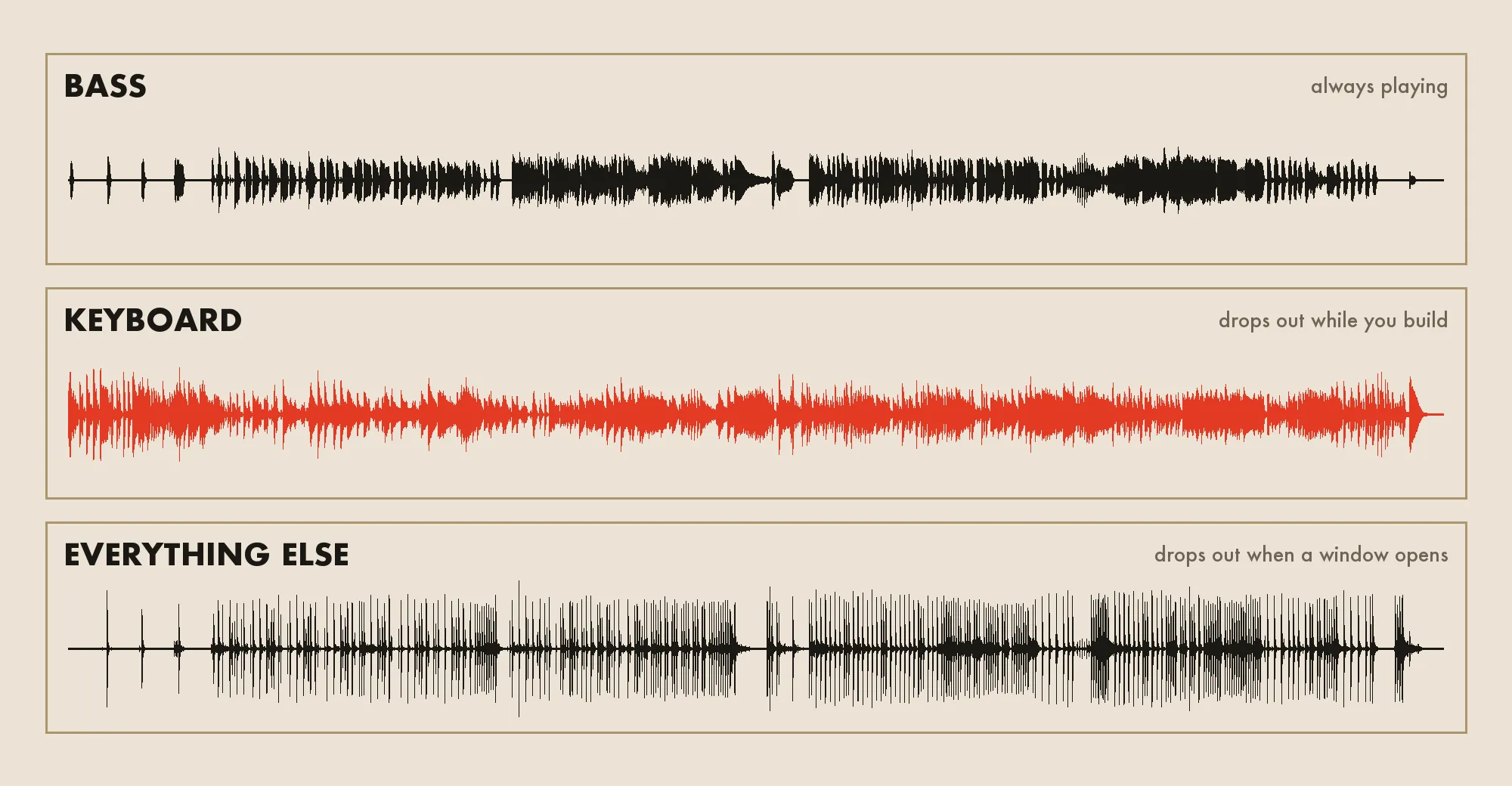
I don’t expect many people to turn the AI-assisted music off, because it’s come out really well. It’s split into stems, so it comes in and out depending on what you’re doing. It cuts back to the bassline, or goes full throttle when it needs to. That adds a lot to the game, but we wanted to give people the option. I know that’s not possible for everyone. Some games are made entirely with AI, and turning it off would mean turning off the game.
And AI in game development more broadly?
I’m somewhat conflicted. Back in the Flash days, that tool let us turn our ideas into interactive art. Using Flash is very different from using a generative AI tool, but what I do really like is that something exists that can bring people’s ideas to life, even when those ideas aren’t very good. I can’t help thinking it will make it harder for players to separate the wheat from the chaff.
One thing I will say: you can spot a good game from a mile off, because there’s passion behind it. It doesn’t really matter what tools were used. I see a lot of trailers made with AI and a lot made without it, and either way you can always spot the passion. Without passion, a bad game will always be a bad game, however it was made.
The skirmish table
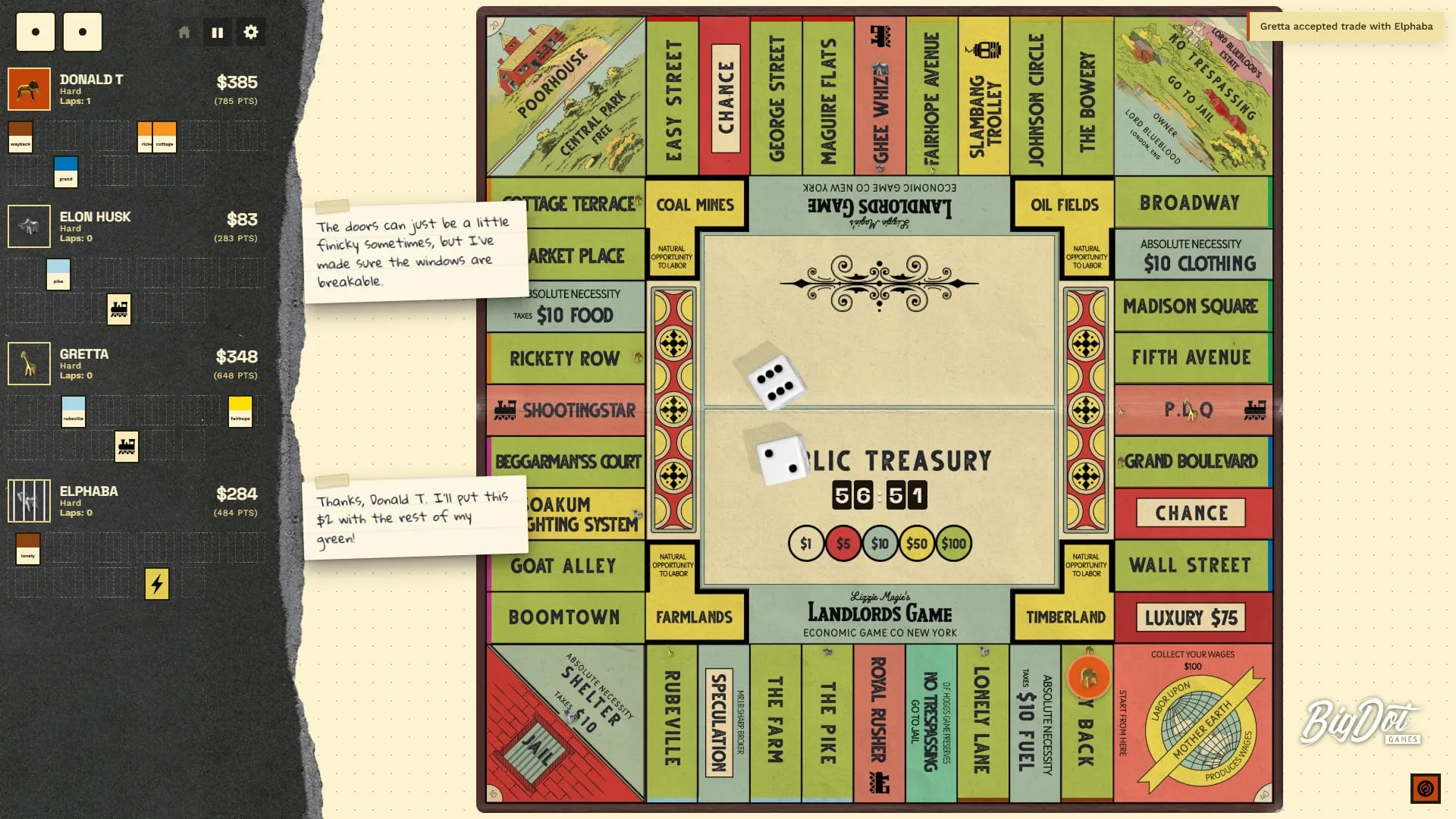
Outside the campaign, your computer opponents include Donald T, Elon Husk, Gretta, Hermione, Elphaba, Snoop and Guybrush, with nearly 2,000 lines of banter between them. How did that happen?
Those are the computer characters you play against in skirmish mode. They’re not part of the campaign. Computer dialogue in these games is often repetitive and shallow, and I wanted to give it some depth. I wanted every session to feel alive and a bit different. That meant writing a lot of dialogue and finding a comedic voice, and chemistry between the characters. They banter, they bicker, and they don’t always say the same thing.
Were you worried about satirising real public figures, some of whom are famously quick to sue?
Any similarity between our larger-than-life fictional computer characters and litigious living figures is purely coincidental.
Looking ahead
If someone plays The Landlords for an evening, what do you hope stays with them?
If one person learns the true history of Monopoly because of my game, I’ll be happy. That person might tell someone else, or go on to make their own game. It’s an interesting story and it deserves to be told. It doesn’t need to be told by a game, either. There are some wonderful books and documentaries people can check out.
If they skip the story and play skirmish instead, I hope some of the humour between our 100% fictional computer characters stays with them, because I’m rather pleased with a lot of it.
And if Lizzie could play it?
I think she’d be quite glad that, a hundred years on, people are finally learning about The Landlord’s Game, even if they’re not fully sold on Georgist economics.
What’s next for Big Dot Games?
I’ll give you the scoop. Our next game will be a classic point-and-click adventure with a twist. It follows a washed-up German author who travels to a remote, sparsely populated island off the coast of Britain after receiving a mysterious letter from an old friend.
Development will take a long time. I’m aiming for five years, so around 2031 or 2032. But I do like games that explore real history, so in the meantime I’ll be keeping an eye out for the next story that deserves to be told.
The Landlords is free on Steam from December 2026.